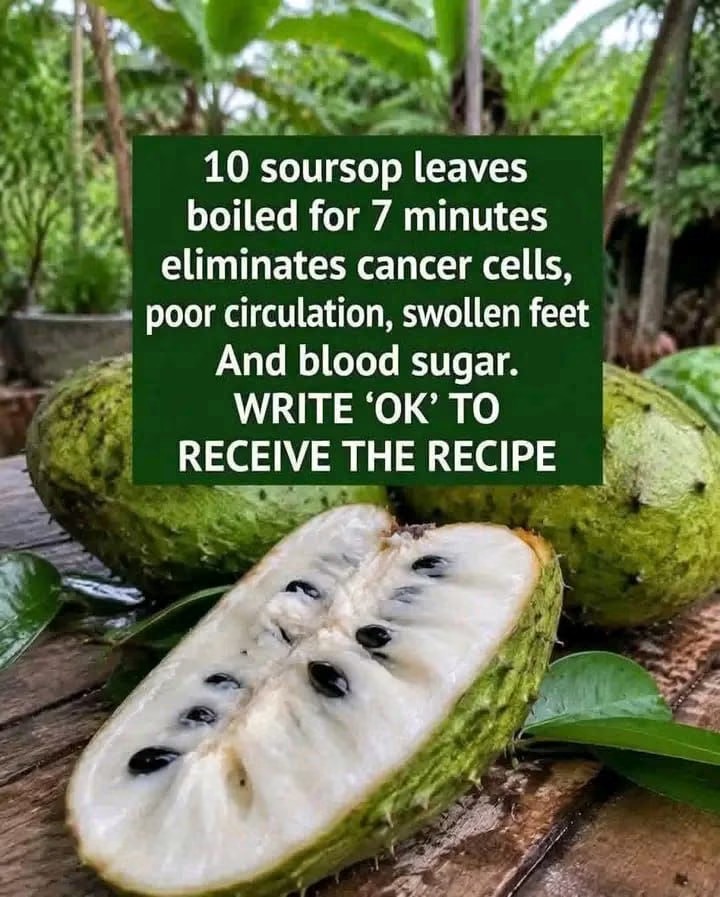
Soursop, also known as graviola, guanábana, corossol, or Annona muricata, is a tropical fruit with green spiky skin and soft white flesh.
Its flavor is creamy, sweet, and pleasantly tart. Many people describe it as a mix of pineapple, strawberry, citrus, and banana.
The ripe fruit can be used in smoothies, juices, desserts, and frozen treats. Its leaves are also boiled as tea in some traditional practices.
However, boiling ten soursop leaves for seven minutes has not been proven to eliminate cancer cells, cure diabetes, improve circulation, or treat swollen feet. The fruit can be enjoyed as food, but concentrated leaf preparations require caution.
What Is Soursop?
Soursop grows on a tropical evergreen tree.
The fruit may be oval, heart-shaped, or irregularly shaped, with a green skin covered in soft-looking spikes.
Inside, the flesh is white, juicy, and fibrous. It contains several hard black seeds that must be removed before eating or blending.
The ripe pulp is naturally rich in flavor and can be used in:
- Fresh juice
- Smoothies
- Ice cream
- Sorbet
- Yogurt drinks
- Fruit bowls
- Homemade frozen pops
- Tropical desserts
The fruit provides fiber, vitamin C, folate, potassium, magnesium, and other nutrients. Eating it occasionally can contribute to a varied, fruit-rich diet.
What People Traditionally Boil
In many communities, fresh or dried soursop leaves are simmered in water to make an herbal infusion.
The number of leaves varies widely from one recipe to another. Some use three leaves, while others recommend ten or more.
There is no standardized medical dose for homemade soursop leaf tea.
The strength can vary depending on:
- The age of the leaves
- The variety of the tree
- The growing conditions
- Whether the leaves are fresh or dried
- The amount of water
- The simmering time
- How frequently the tea is consumed
This makes it impossible to know precisely how much of the plant’s active compounds are present in a homemade cup.
Can Soursop Eliminate Cancer Cells?
Soursop extracts have attracted scientific interest because they contain natural compounds known as annonaceous acetogenins.
Some concentrated extracts have affected cancer cells in laboratory experiments.
However, a result observed in a laboratory dish does not prove that drinking leaf tea or eating the fruit will cure cancer in the human body.
Soursop has not been shown to treat cancer in human clinical studies, and it must not replace surgery, radiation, chemotherapy, immunotherapy, targeted therapy, or other treatment prescribed by an oncology team.
Anyone receiving cancer treatment should tell the medical team about herbal teas, capsules, powders, extracts, and supplements.
Natural products can interact with medication or make treatment side effects more difficult to manage.
Soursop and Blood Sugar
Soursop has also been studied for possible effects on blood sugar, mainly through laboratory and animal research.
That does not establish homemade leaf tea as a safe diabetes treatment.
People who take insulin or other glucose-lowering medication should be particularly cautious. Soursop may add to the medicine’s effects and potentially contribute to blood sugar becoming too low.
Possible symptoms of low blood sugar include:
- Shaking
- Sweating
- Sudden hunger
- Dizziness
- Weakness
- Confusion
- Blurred vision
- Fainting
Never reduce or stop diabetes medication because of an herbal drink.
The fruit also contains natural carbohydrates, so its portion should be considered as part of the meal plan.
Can It Improve Circulation?
Poor circulation is not one single condition.
Symptoms such as cold feet, leg discomfort, swelling, numbness, slow-healing wounds, or color changes may be linked to diabetes, artery disease, vein problems, heart conditions, nerve damage, medication effects, or other causes.
Soursop tea has not been proven to correct these problems.
Regular walking, managing blood pressure and blood sugar, avoiding tobacco, and following medical advice are more dependable ways to support circulatory health.
Anyone with a painful, cold, pale, blue, or suddenly swollen limb should seek medical attention rather than depending on tea.
Swollen Feet Need Attention
Foot and ankle swelling may occur after standing for a long time or eating a salty meal.
It can also be connected to injury, infection, vein disease, medication, heart problems, kidney disease, liver disease, or a blood clot.
Seek urgent help when swelling:
- Appears suddenly
- Affects only one leg
- Is painful, hot, or red
- Occurs with chest pain
- Comes with shortness of breath
- Is associated with faintness or confusion
Persistent swelling in both feet should also be assessed, particularly when it occurs with reduced urination, rapid weight gain, unusual fatigue, or breathing difficulty.
A homemade tea should never delay that evaluation.
Soursop Leaf Safety Concerns
Soursop contains a natural compound called annonacin.
Laboratory and animal research has raised concerns that repeated or high exposure to annonacin may harm nerve cells. Studies have also explored a possible association between frequent consumption of Annonaceae products and atypical parkinsonian disorders in certain populations.
This does not mean that one occasional serving of ripe fruit will automatically cause harm.
It does mean that concentrated leaf tea should not be treated as an unlimited daily beverage.
Long-term, frequent consumption of strong leaf decoctions is best avoided.
A Mild Traditional Leaf Infusion
Because the strength and long-term safety of soursop leaf preparations are uncertain, this recipe uses fewer leaves than many social-media versions.
It is intended only for adults who have discussed regular herbal use with a qualified healthcare professional.
Preparation time: 5 minutes
Steeping time: 7 minutes
Yield: 2 cups
Ingredients
- 2 properly identified fresh soursop leaves
or 1 teaspoon dried food-grade soursop leaves - 2½ cups water
- 1 thin slice fresh ginger, optional
- 1 teaspoon fresh lime juice, optional
- ½ teaspoon honey, optional
How to Prepare It
Inspect the leaves carefully.
Use only leaves from a correctly identified soursop tree that has not recently been treated with pesticides or other garden chemicals.
Wash fresh leaves thoroughly under clean running water.
Place the water in a small saucepan and bring it to a gentle boil.
Add the leaves and optional ginger.
Reduce the heat and simmer gently for three minutes.
Turn off the heat.
Cover the saucepan and let the leaves steep for another four minutes.
Strain the liquid carefully.
Allow it to cool slightly before adding lime juice or honey.
Begin with half a cup rather than a large serving.
Do not prepare an extremely dark or concentrated infusion.
Who Should Avoid the Leaf Tea?
Soursop leaf tea is not appropriate for everyone.
Avoid concentrated soursop preparations during pregnancy and breastfeeding unless a qualified professional specifically approves them.
Children should not receive medicinal-strength soursop tea.
People with Parkinson’s disease, tremors, movement disorders, balance problems, or other neurological conditions should avoid regular use because of the unresolved neurotoxicity concerns.
Extra caution is also important for people using:
- Diabetes medication
- Blood-pressure medication
- Cancer treatment
- Multiple herbal supplements
- Medicines that may cause dizziness
- Medicines that affect the nervous system
Soursop may lower blood pressure or blood sugar, which could intensify the effects of certain medications.
Creamy Soursop Fruit Drink
The ripe fruit pulp is a more practical way to enjoy soursop than making strong leaf tea.
This recipe is creamy, tropical, and naturally refreshing.
Preparation time: 15 minutes
Servings: 4
Ingredients
- 2 cups ripe soursop pulp
- 3 cups cold water
- 1 cup unsweetened coconut milk or pasteurized milk
- 1 tablespoon fresh lime juice
- ½ teaspoon vanilla extract, optional
- 1 tablespoon honey, optional
- Ice cubes for serving
How to Make It
Wash the outside of the fruit before cutting it.
Slice the soursop lengthwise.
Scoop the soft white pulp into a clean bowl.
Carefully remove every black seed.
Check the pulp twice because the seeds can hide between its creamy sections.
Discard the skin, seeds, and hard central core.
Place two cups of cleaned pulp in a blender.
Add the water, coconut milk, lime juice, and vanilla.
Blend until smooth.
Taste the drink before adding honey.
A fully ripe soursop may already be sweet enough.
For a smoother consistency, strain the drink through a medium-mesh strainer.
Serve immediately over ice or refrigerate it briefly before serving.
Important Seed Warning
Do not eat, crush, grind, or blend the black seeds.
Remove every seed before making juice, smoothies, desserts, or frozen treats.
The seeds are not intended for consumption.
They can be slippery and surprisingly good at hiding, so take your time during preparation.
Easy Fruit Variations
Soursop and Pineapple
Blend one and a half cups of soursop pulp with one cup of pineapple, three cups of water, and a squeeze of lime.
Soursop Banana Smoothie
Blend one cup of soursop pulp with one small banana, one cup of milk, half a cup of water, and ice.
Soursop Coconut Cooler
Combine soursop pulp with coconut water instead of milk for a lighter, more refreshing drink.
Frozen Soursop Pops
Blend two cups of pulp with one cup of plain yogurt and a little lime juice.
Pour the mixture into ice-pop molds and freeze for at least six hours.
Storage
A whole firm soursop can remain at room temperature until it softens slightly.
Check it daily because ripe soursop spoils quickly.
Once ripe, refrigerate it and use it within one or two days.
Cleaned fruit pulp should be stored in an airtight container in the refrigerator and used within two days.
For longer storage, freeze seed-free pulp in small portions for up to three months.
A milk-based soursop drink should be refrigerated immediately and consumed within 24 hours.
A water-based fruit drink may keep for up to two days when prepared hygienically and kept cold.
Discard the drink if you notice:
- Mold
- Unexpected bubbles
- Pressure building in the bottle
- A fermented or alcoholic smell
- Sliminess
- An unpleasant sour taste
Frequently Asked Questions
Can ten leaves cure cancer?
No.
There is no proven leaf number, boiling time, or homemade recipe that eliminates cancer cells in people.
Is the ripe fruit safe?
The ripe pulp is commonly eaten as food.
Remove the skin, central core, and every black seed.
Can I drink the leaf tea every day?
Regular long-term use is not recommended because the safety is uncertain and annonacin exposure has raised neurological concerns.
Can soursop replace diabetes medicine?
No.
It may also interact with glucose-lowering treatment, so regular use should be discussed with a healthcare professional.
Can soursop reduce swollen feet?
It has not been proven to treat the underlying causes of swelling.
Sudden or persistent swelling deserves medical evaluation.
Can I use dried leaves?
Only use dried leaves sold and labeled for food or tea preparation.
Decorative or unidentified leaves should not be consumed.
Can the fruit be frozen?
Yes.
Remove all seeds, divide the pulp into portions, and freeze it in airtight containers.
Final Thoughts
Soursop is a delicious tropical fruit with creamy flesh and a flavor that seems to combine several fruits in one green package.
Its ripe pulp can be used in refreshing drinks, smoothies, desserts, and frozen treats.
The leaves may have a long history of traditional use, but that history does not prove they can eliminate cancer, cure diabetes, improve circulation, or remove swelling.
Enjoy the fruit in sensible portions, remove every seed, and approach concentrated leaf preparations with caution.
Soursop is far more enjoyable when it is allowed to be a tropical fruit rather than being asked to perform the work of an entire hospital.