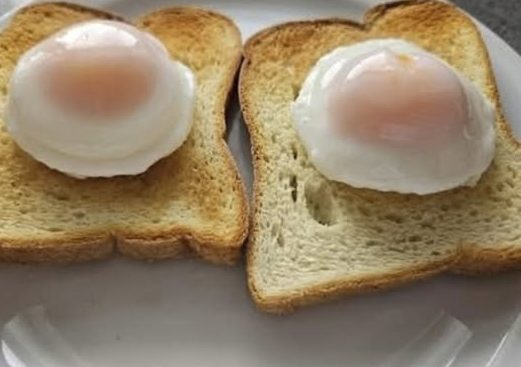
Perfectly poached eggs are one of the simplest foods that somehow feel the hardest to master. The idea is straightforward: tender whites, a soft center, and a smooth shape. Yet in practice, poached eggs often turn into wispy, uneven clouds drifting through the pot. The yolk may cook too fast, the whites may scatter, and the final result rarely looks as neat as expected.
This frustration has led home cooks to try every trick imaginable. Vinegar in the water. Swirling whirlpools. Fresh eggs only. Special pans. While these methods can help, they often introduce extra steps, strong smells, or inconsistent results.
There is, however, a clever kitchen hack that quietly solves most of these problems. It produces poached eggs that are smooth, round, and evenly cooked, with minimal effort and no complicated technique. Once you try it, the method feels almost obvious.
The secret lies in gently pre-shaping the egg before it ever touches the hot water.
Instead of cracking the egg directly into simmering water, the egg is first strained briefly in a fine-mesh sieve. This simple step removes the loose, watery part of the egg white that causes most of the messy strands during poaching.
Egg whites are made up of two parts. One is thick and clings closely to the yolk. The other is thinner and more liquid. That thin portion is what drifts away in the water, creating those feathery edges that make poached eggs look untidy.
By letting the egg sit in a sieve for just a few seconds, the watery white drains away while the thicker white stays wrapped around the yolk. What remains is a compact, naturally rounded egg that is already shaped for poaching.
To use this hack, start by cracking a fresh egg into a small fine-mesh strainer set over a bowl or sink. Let it rest for about ten to fifteen seconds. You will see a clear liquid drip through the mesh. This is the part that causes spreading during poaching.
Once the dripping slows, gently transfer the egg into a small cup or ramekin. At this point, the egg will already look neater and more cohesive.
Bring a pot of water to a gentle simmer. The water should be hot but not boiling aggressively. Large bubbles can disturb the egg and break its shape. A calm surface with small bubbles rising occasionally is ideal.
You do not need vinegar for this method. Vinegar can tighten egg whites quickly, but it also adds a sharp smell and flavor that some people dislike. Because the loose whites have already been removed, the egg will hold together naturally.
Lower the cup close to the surface of the water and gently slide the egg in. Because the egg is already compact, it will sink slightly and then settle without spreading. No swirling is necessary.
As the egg cooks, the thick white sets evenly around the yolk, forming a smooth, round shape. After about two to three minutes, the whites will be fully set and the yolk will remain soft and tender.
Using a slotted spoon, lift the egg from the water and let excess liquid drain away. The result is a beautifully shaped poached egg with clean edges and a uniform appearance.
This method works because it respects the structure of the egg instead of fighting it. Rather than forcing the whites to behave in hot water, it removes the part that causes the problem in the first place.
Another advantage of this hack is consistency. Once you understand how much white drains away, you can repeat the process easily. Every egg cooks similarly, making it ideal for preparing multiple eggs for breakfast or brunch.
This technique is especially useful when presentation matters. Poached eggs served on toast, avocado, smoked salmon, or salads look noticeably more refined when the whites are smooth and round. The eggs sit neatly on the plate instead of spreading outward.
It is also a great method for beginners. Many people avoid poached eggs because they seem intimidating. This approach removes most of the uncertainty and replaces it with a calm, predictable process.
Fresh eggs still produce the best results, but this hack helps even slightly older eggs behave better. The older an egg is, the more watery the whites become, making straining even more helpful.
Some cooks worry that straining wastes part of the egg. In reality, the drained liquid white is minimal and does not affect the flavor or nutrition of the finished egg in a noticeable way. What you gain in appearance and ease far outweighs what is lost.
This method also pairs well with batch cooking. You can strain several eggs ahead of time, placing each into its own small cup. When the water is ready, simply slide them in one by one. This makes it easy to serve multiple people without stress.
Temperature control remains important. Keeping the water at a gentle simmer prevents the egg from bouncing or tearing. If the water becomes too hot, simply lower the heat for a moment before adding the egg.
Timing can be adjusted based on preference. A shorter cooking time results in a very soft yolk. An extra thirty seconds produces a slightly jammy center. The whites will stay smooth and intact either way.
This hack has become popular because it focuses on simplicity. No special tools are required beyond a basic kitchen strainer. No strong additives are needed. The process feels clean, controlled, and intuitive.
Perfectly round poached eggs may seem like a small victory, but they often change how people feel about cooking breakfast. When something that once felt difficult becomes easy, it encourages confidence and creativity in the kitchen.
Poached eggs are a foundation of many classic dishes, and mastering them opens the door to countless meals. From simple toast to elegant brunch plates, the humble poached egg plays a starring role.
In the end, this clever kitchen hack is not about perfection for its own sake. It is about making cooking more enjoyable. When results improve without added stress, the process becomes something to look forward to rather than avoid.
Perfectly round poached eggs are no longer a matter of luck or special equipment. With a fine-mesh strainer and a few calm moments, they become a reliable, repeatable part of everyday cooking.